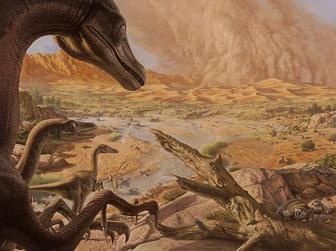
Troodontids; best exemplified by the genera Saurornithoides (from western Mongolia), Troodon (from North America), and Sinornithoides; were small (about the size of a small adult human), with long and slender hind limbs useful for rapid locomotion, and a long skull filled with distinctive recurved and saw-edged teeth. Troodontid manus (hands -- manus is spelled the same for the singular and plural) were large and flexible, capable of precise grasping movements. The pedes (feet) bore an enlarged claw similar to those of the Dromaeosauridae, but not as large, and probably not used in predation. The most interesting feature of troodontids is their skull - the brain case is the largest relative to body size of all non-avian dinosaurs, the orbits (eye openings in the skull) are very large, and the brain cavity suggests well developed centers for sight and hearing. Were troodontids the smartest dinosaurs of their time? Maybe, but measuring intelligence even on living animals is an imprecise and speculative matter in its own right; measuring the intelligence of extinct animals from fragmentary bones is mostly fantasy, but probably close to the truth. Troodontids, judging from their cranial anatomy and cursorial daptations, were likely agile, fast carnivores with acute senses. Like all other non-avian dinosaurs, however, they vanished at the end of the Mesozoic era.
|
 The Troodontidae are a small group (maybe 5 different species) of very rare and hence poorly known maniraptorans. They are only known from a few incomplete specimens from the Cretaceous period of North America and Mongolia, so their exact affinities to other maniraptorans are uncertain. It has been suggested that they were the ancestors of birds, but this is not accepted; a dromaeosaur is currently thought to be the ancestor of all birds. Even though dromaeosaur and troodontids are outwardly similar, scientists are not certain yet that they are closely related, but are confident that troodontids lie within the clade Maniraptora.